




Blog
SimpliPHI 6.6 Battery Passes Earthquake Vibration Test

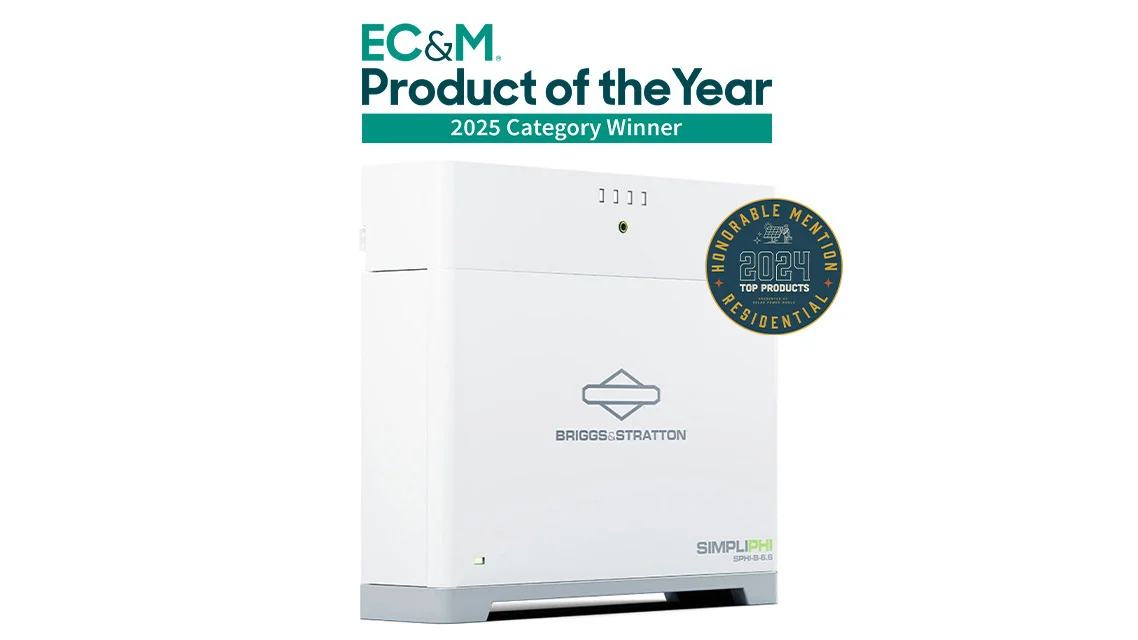
Energy storage systems are becoming an increasingly important part of residential and commercial power infrastructure. But when choosing a battery system, capacity and performance are only part of the equation. Durability, safety and the ability to withstand demanding environmental conditions can be just as important.
Briggs & Stratton Energy Solutions recently reached an important milestone with its SimpliPHI 6.6 battery. The stackable lithium iron phosphate battery successfully passed a rigorous earthquake vibration test designed to evaluate how equipment responds to seismic movement.
The achievement provides another demonstration of the engineering behind the SimpliPHI 6.6 and is particularly relevant for energy storage installations in areas where resilience is an important consideration.
What Earthquake Vibration Test Did the SimpliPHI 6.6 Pass?
The SimpliPHI 6.6 was subjected to the GR-63-CORE, Issue 5, Section 4.4.1 earthquake vibration test. The testing was conducted by Element U.S. Space & Defense.
According to Briggs & Stratton Energy Solutions, the test configuration consisted of three SimpliPHI 6.6 batteries stacked together with a battery controller positioned on top.
The system was evaluated in both ground-mounted and wall-mounted configurations. During the rigorous vibration testing, the battery system remained powered on and sustained no physical damage.
This is an important distinction. Passing the test does not mean that a battery system should simply be described as “earthquake-proof.” Instead, the test provides measurable evidence of how the system performed under a recognized seismic vibration testing procedure.
Why Seismic Testing Matters for Energy Storage
Battery energy storage systems are substantial pieces of electrical equipment. A residential battery system may remain installed on a property for many years while being exposed to temperature changes, humidity, vibration and other environmental conditions.
In regions susceptible to seismic activity, the mechanical integrity of the battery installation becomes another consideration.
An energy storage system must do more than store electricity efficiently. Its enclosure, internal components, electrical connections, mounting system and battery modules must work together as an integrated system.
Testing the equipment under controlled vibration conditions provides engineers, installers and customers with additional information about the mechanical durability of the design.
Why This Is Particularly Relevant for Puerto Rico
For Puerto Rico, energy resilience has become an important consideration when designing residential and commercial power systems.
Solar generation combined with battery storage can help provide backup electricity during grid interruptions while also allowing property owners to store solar energy for later use.
Puerto Rico is also located in a seismically active region. This makes structural considerations particularly relevant when installing equipment that may remain attached to a wall or mounted on the ground for many years.
The SimpliPHI 6.6 has another important connection to Puerto Rico: Briggs & Stratton announced in 2024 that the battery received the Certification of Renewable Energy Equipment from Puerto Rico’s Oficina de Gerencia de Permisos (OGPe).
That certification cleared the SimpliPHI 6.6 for sale in Puerto Rico and makes the battery especially relevant to local renewable-energy installations.
What Is the SimpliPHI 6.6 Battery?
The SimpliPHI 6.6 is a modular energy storage battery developed by Briggs & Stratton Energy Solutions for applications including residential backup power, solar-plus-storage systems, time-of-use energy management and off-grid installations.
Each battery provides approximately 6.65 kWh of energy storage capacity.
The modular architecture allows customers and installers to configure the amount of storage according to the requirements of a particular property.
One battery provides 6.65 kWh, while three batteries can be combined into a single stack providing approximately 19.95 kWh.
For applications requiring substantially greater storage, the architecture can scale to six stacks containing a maximum of 18 batteries. This provides up to approximately 119.7 kWh of total energy storage.
LFP Battery Chemistry
The SimpliPHI 6.6 uses lithium iron phosphate (LFP) battery chemistry.
LFP has become widely used in stationary energy storage because of characteristics including thermal stability, long cycle life and the absence of cobalt in the battery chemistry.
For a stationary battery that may charge and discharge repeatedly over many years, battery chemistry is an important part of the overall system design.
Briggs & Stratton designed the SimpliPHI platform around LFP technology for applications where reliability, safety and long-term energy storage performance are priorities.
A Compact and Scalable Energy Storage System
One of the biggest advantages of the SimpliPHI 6.6 architecture is scalability.
Not every homeowner requires the same amount of energy storage. Factors such as electricity consumption, solar production, critical loads, air conditioning, appliances and desired backup duration can significantly change battery requirements.
A modular architecture allows an energy storage system to be designed around those requirements instead of forcing every installation into the same battery capacity.
A smaller property could begin with a single 6.65 kWh module, while larger homes or commercial applications can use multiple batteries and stacks.
This flexibility can also make future expansion easier when properly planned as part of the original system design.
RapidStak Technology Simplifies Installation
Briggs & Stratton developed its RapidStak™ connector system to simplify battery installation.
Power and communication connections are integrated into a single connection between battery modules. The batteries stack together without requiring individual wiring or DIP-switch configuration between modules.
According to Briggs & Stratton, installers can physically assemble a three-battery stack with its controller in under five minutes.
Reducing the number of individual connections can help simplify installation, reduce complexity and create a cleaner overall system configuration.
Designed for Indoor and Outdoor Installation
Energy storage systems must often accommodate properties where available installation space is limited.
The SimpliPHI 6.6 provides several installation options. When properly installed as a system, it carries an IP65 rating and is designed for both indoor and outdoor applications.
The system can be ground-mounted or wall-mounted, giving installers greater flexibility when working with garages, utility areas, exterior walls and other appropriate locations.
Its outdoor capability also means that an additional weather enclosure is not necessarily required for the battery itself when installed according to manufacturer requirements.
Designed for a Wide Temperature Range
Temperature can significantly influence battery performance, making operating range another important consideration when evaluating an energy storage system.
Briggs & Stratton specifies a discharge operating temperature range of approximately -20°C to 55°C (-4°F to 131°F) for the SimpliPHI 6.6.
The specified charging temperature range extends from approximately -10°C to 50°C (14°F to 122°F).
This broad operating range allows the battery platform to accommodate a variety of climates and installation environments when installed according to applicable requirements.
Safety Testing and Certifications
The earthquake vibration test is only one part of the testing and certification behind the SimpliPHI 6.6.
Depending on current configuration and certification status, Briggs & Stratton lists standards and testing associated with the platform including UL 9540, UL 9540A, UL 1973, UL 1642, UN 38.3 and UN 3480.
UL 9540A testing is particularly relevant to energy storage because it evaluates thermal runaway fire propagation characteristics of battery energy storage technology.
Together, these certifications and tests provide installers, regulators and customers with standardized information for evaluating energy storage safety and compliance.
More Than Backup Power
Although battery storage is frequently associated with blackouts, systems such as the SimpliPHI 6.6 can serve several purposes.
The batteries can be configured for backup power, allowing stored electricity to supply selected loads when utility power is unavailable.
They can also be paired with solar panels, allowing excess solar production generated during daylight hours to be stored rather than immediately consumed.
Depending on the electrical system, utility rate structure and configuration, stored energy can potentially be used during periods when purchasing electricity from the grid is more expensive.
For appropriately designed systems, batteries can also form part of an off-grid configuration incorporating solar generation and other power sources.
Integration With Leading Inverter Platforms
A battery does not operate independently of the rest of an energy storage system. Communication between the battery management system and inverter can be important for controlling charging, discharging and system operation.
Briggs & Stratton has developed closed-loop integration support for several leading 48V inverter platforms.
Current integration resources include systems from Sol-Ark, EG4, Growatt and Megarevo, among others, depending on the inverter model and system configuration.
This gives system designers greater flexibility when creating residential or commercial energy storage installations.
What the Earthquake Test Really Tells Consumers
Technical certifications can sometimes become marketing claims that are difficult for homeowners to interpret.
The important takeaway from this particular test is relatively straightforward.
A three-battery SimpliPHI 6.6 stack with its controller was subjected to the GR-63-CORE earthquake vibration testing procedure. During the test, the system remained operational and sustained no physical damage.
That does not guarantee how every installation will perform during every earthquake. Installation method, building construction, mounting surface, local codes and the severity of an actual seismic event are all important variables.
What the result does demonstrate is that Briggs & Stratton has subjected the battery system to rigorous third-party dynamics testing and successfully completed that particular test.
Energy Resilience Requires More Than Battery Capacity
When comparing home energy storage systems, consumers naturally focus on kilowatt-hours. Capacity is important, but it should not be the only consideration.
A properly designed energy storage system should also consider battery chemistry, inverter compatibility, installation requirements, environmental protection, safety testing, system scalability and the loads the homeowner expects to operate during an outage.
The SimpliPHI 6.6’s successful earthquake vibration test adds another factor to that evaluation: mechanical durability under demanding vibration conditions.
A Significant Milestone for the SimpliPHI Platform
The successful earthquake vibration test represents an important milestone for Briggs & Stratton Energy Solutions and its SimpliPHI battery platform.
Combined with LFP chemistry, modular 6.65 kWh capacity, scalable configurations reaching 119.7 kWh, indoor and outdoor installation flexibility and multiple safety certifications, the test reinforces the company’s focus on developing energy storage systems for demanding real-world applications.
For markets such as Puerto Rico, where homeowners and businesses increasingly value energy resilience, these characteristics can be particularly relevant when evaluating a battery storage solution.
Conclusion
The Briggs & Stratton Energy Solutions SimpliPHI 6.6 battery successfully passing the GR-63-CORE earthquake vibration test demonstrates an important aspect of energy storage that consumers may sometimes overlook: physical durability.
During third-party testing, a three-battery stack remained powered and sustained no physical damage under the specified vibration test conditions.
Combined with its scalable design, LFP chemistry, RapidStak installation system, indoor/outdoor flexibility and extensive safety testing, the SimpliPHI 6.6 represents an interesting option in the rapidly evolving energy storage market.
For Puerto Rico in particular, its OGPe certification, renewable-energy applications and demonstrated performance under seismic vibration testing make the technology especially relevant to conversations about building more resilient energy systems.
Explore Energy Storage Solutions With Multibatteries & Forklifts, CRL
Choosing the right battery storage system starts with understanding your property’s energy consumption, backup requirements and renewable-energy goals.
Multibatteries & Forklifts, CRL provides battery and renewable-energy solutions for residential and commercial applications in Puerto Rico. Our team can help you explore energy storage, battery banks, inverter systems and renewable-energy equipment designed around your specific requirements.
Phone: 787-704-7100
Email: Info@mbfpr.com